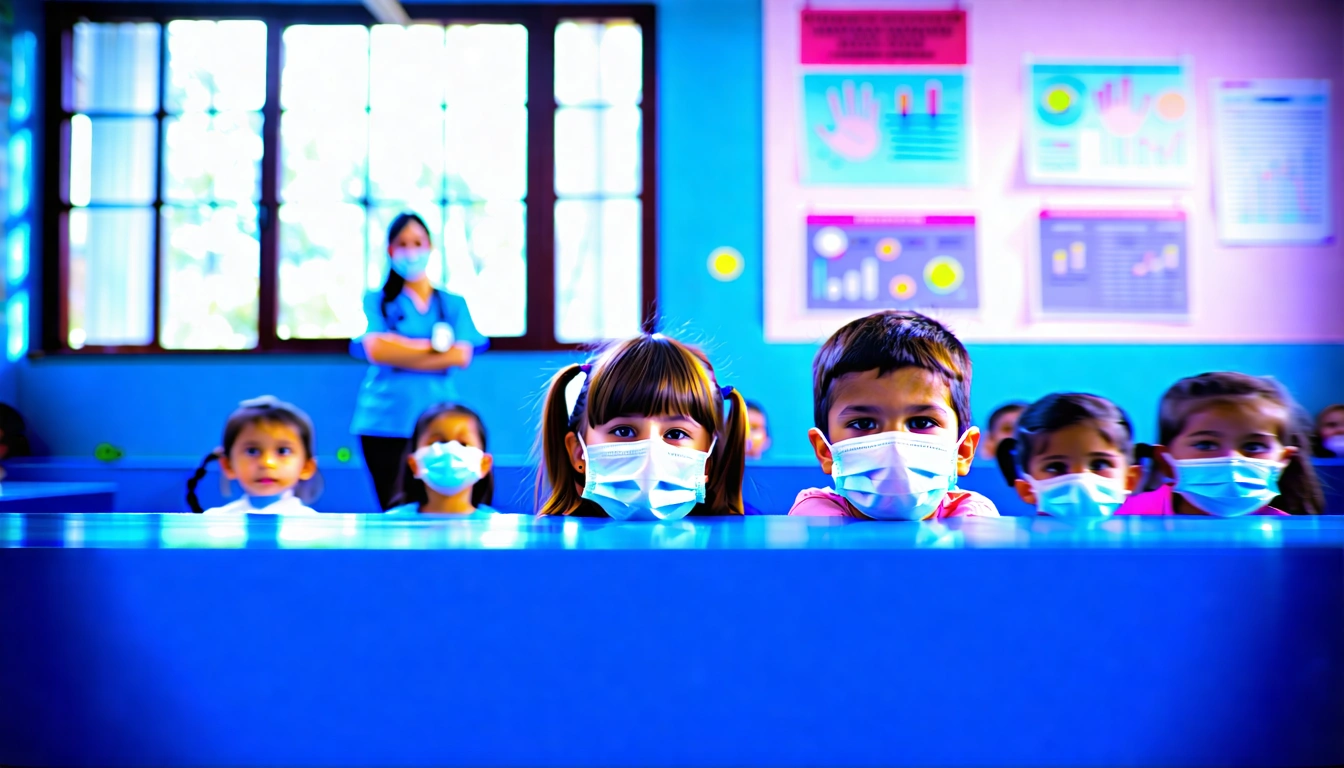
Children are being hospitalized with COVID19 in record numbers across the United States. As most children are not old enough to get vaccinated, hospitalizations could further increase as schools reopen. Doctors and epidemiologists are thus calling for the use of safety precautions, such as masks and ventilation, during class.
In a new feature, MNT explores the risks of SARSCoV2 spreading among children and looks at what strategies might prevent it. The rise in cases of COVID19 among children in the US is primarily linked to the Delta variant. Cases are rising especially quickly in communities with low rates of COVID19 vaccinations.
Although the Centers for Disease Control and Prevention CDC recommend universal indoor masking and physical distancing in schools, mask wearing is optional in North Dakota and Ohio.
Rapidly increasing infection rates among children and teachers have forced many schools in the US to halt inperson learning and turn to hybrid models of education. This comes despite 175 pediatric disease experts agreeing earlier this year that elementary schools could open full time for inperson instruction.
Although children generally have milder COVID19 symptoms than adults, the fact that few studies have investigated how the disease affects children means that many questions remain unanswered. For example, why are so many children being hospitalized with COVID19 Which children are most at risk And what can parents and authorities do so that children can return to school safely
To answer these questions and more, Medical News Today spoke with seven doctors and researchers who specialize in pediatrics and infectious diseases and have worked directly with children with COVID19.
The Delta variant of COVID19 is more than two times as contagious as previous variants. Alongside school reopenings, this may partially explain the increase in pediatric hospitalizations due to COVID19.
The Delta variant that is circulating widely is more contagious, and children are getting infected more often than previously during the pandemic, Michael L Chang MD, director of pediatric antimicrobial stewardship for McGovern Medical School and Childrens Memorial Hermann Hospital in Texas, told MNT. Also, across the country, mitigation measures such as masks, reduced occupancy indoors, physical distancing, all ended around the same time.
Now, you have a more contagious variant with fewer mitigation measures in place. With the rising number of cases, unfortunately, you will see more hospitalizations. As an example, if 2 percent of children need hospitalization, then it is a big difference between 2 percent of 10000 cases vs 2 percent of 100000 cases, he added.
Another reason for rising COVID19 hospitalizations among children may be that those under the age of 12 years cannot get the vaccination yet.
Vaccines remain effective at preventing severe illness, hospitalization, and death from SARSCoV2 infection, even Delta strain infection, Kristin Moffitt MD, an infectious disease expert at Boston Childrens Hospital MA, told MNT. This is consistent with reports that the overwhelming majority of hospitalizations and deaths during the recent surge are occurring in unvaccinated individuals.
Since children under 12 are not yet able to be vaccinated, and many adolescents and young adults remain unvaccinated relative to older individuals, this age group is making up a bigger proportion of those at risk for severe illness based on their unvaccinated status, she added.
Early in the pandemic, those over 65 accounted for more severe disease and hospitalization. Now that this age group has a higher percentage of vaccinated persons, the disease burden will be seen in the younger, unvaccinated population, said Dr Adriana Cadilla, an infectious diseases pediatric specialist at Nemours Childrens Hospital in Orlando FL. In Florida, there has been over a fourfold increase in child SARSCoV2 infections in the past month, Dr Cadilla added.
Although the number of COVID19 cases among children is increasing more quickly now than at any other time in the pandemic, it is unclear whether the Delta variant of SARSCoV2 is more severe for children than previous variants.
We do not know if the Delta variant causes more severe disease for kids than previous variants, but it is definitely more contagious, said Dr Chang.
Due to low testing and hospital admissions among children from previous variants, the data to compare the outcome of COVID19 strains are sparse. As schools reopen, however, and safety precautions such as mask wearing wane, more children are becoming infected with SARSCoV2 at the same time, leading to higher numbers of children developing severe COVID19.
There are some indications to suggest that COVID19 from the Delta variant is more severe in children than with earlier strains, Dr Allison Ross Eckard MD, professor of pediatrics and medicine at the Medical University of South Carolina, told MNT.
We are seeing a greater number of children, particularly unvaccinated adolescents, with more severe COVID19 resulting in respiratory failure that is requiring intubation and sometimes ECMO heart lung bypass machine, ARDS a very serious lung condition that develops as a result of the inflammation associated with COVID19, and other COVID related problems, all complications we more commonly see in adults, she continued.
It may be that the increased number of hospitalizations among children is a result of both of these factors, more cases combined with a higher chance of severe disease. More data is needed to determine the exact reasons behind what we are seeing, she added.


Pediatrics